
















You are lying in bed in the evening, reading a message for the fifth time and searching for the one sentence that will finally tell you what to do. But the more you analyse, the further you drift from your answer. Getting out of your head and into your intuition doesn't mean having no more thoughts. It means noticing again what has long been speaking quietly to you beneath the noise of your thoughts.
Your intuition is not a spectacular flash of insight that always arrives with goosebumps and a clear yes. It is often much quieter: a sense of space in your chest, an inner hesitation, a sudden clear no or the calm that stays when you stop overthinking a decision. It is your connection to yourself: to your experiences, your values, your body and your truth.
INTUITION FLOW Coaching and MANIFESTATION Workshop
Getting out of your head and into your intuition starts in your body
The head wants certainty. It plays through possibilities, rehearses conversations in advance and looks for proof before it lets go. That isn't wrong. Your mind protects you, plans and recognises connections. It only becomes difficult when it overrules every inner stirring and turns a simple decision into an endless construct of thoughts.
Intuition, on the other hand, can often be felt in the body. Maybe your stomach tightens when you accept an invitation even though you are exhausted. Maybe your breath becomes freer as soon as you think of the path you actually want to take. The body doesn't judge with arguments. It sends signals: direct, honest and sometimes uncomfortable.
So before you search for an answer, pause for a moment. Put both feet on the floor. Place one hand on your heart and the other on your belly. Breathe in and out slowly. Don't immediately ask yourself: “What is the perfect decision?” Ask instead: “How does this possibility feel inside me?”
This is not a test you have to pass. It is an invitation to turn your attention inwards. The more often you do this, the more familiar your own language becomes.
Intuition or fear? The subtle difference
Not every strong feeling is intuition. Especially when you are tired, hurt, overwhelmed or emotionally stirred up, fear can sound very convincing. It usually wants to push you: “Decide now”, “You mustn't make a mistake”, “This is bound to go wrong.” Fear makes things narrow, loud and hectic.
Intuition can warn you about something too. Its tone, however, is usually clearer and calmer. It doesn't need to argue. It tends to say: “This doesn't fit right now”, “Wait a little longer” or “Here you can allow yourself more.” Sometimes an intuitive step still feels brave, because growth is rarely completely comfortable. The difference isn't whether you feel nervous, but whether there is a quiet, coherent knowing beneath the nervousness.
Give yourself time when you are unsure. Sleep on it, go for a walk without a podcast or write your thoughts down. What remains after the first wave often tells you more than the loudest impulse.
A small ritual for your inner voice
You don't need a perfect altar or an hour of free time to come back to yourself. A conscious ritual helps because it draws a clear line in your day: up to here, the outside world was allowed to speak. Now I listen to myself.
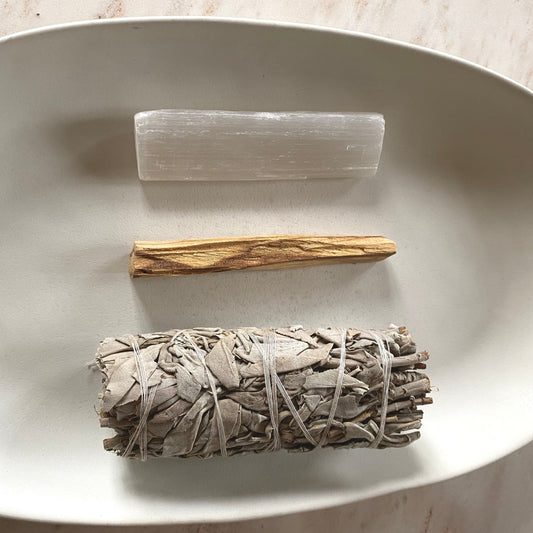
Choose a moment that realistically fits into your life: in the morning before you first reach for your phone, between work and evening or before going to sleep. Light a candle, open a window or put a few drops of ritual oil into your hands. The scent, the warm light and a conscious touch alone can help you step out of autopilot.
Then draw an affirmation card or choose a sentence to accompany you today. Not to talk yourself into something, but to set your focus. A sentence like “I trust my inner guidance” can be a powerful reminder if you don't just read it, but feel it for a moment.
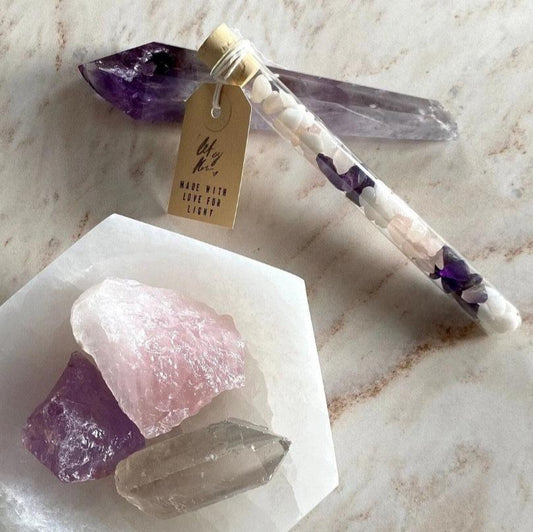
At LETGOFLOW, small anchors like these are at the heart of the rituals: lovingly designed High Vibe Goods are allowed to be beautiful and serve a real purpose at the same time. A candle, a crystal or a card won't make a decision for you. But it can remind you that you are allowed to listen to yourself.
Afterwards, write three short answers in a notebook: What is really on my mind? What do I feel beneath all my thoughts? What would be a small, loving next step? It isn't about solving your whole life on one page. It is enough if you are one percent clearer after the ritual.
Trust your intuition in small decisions
Many people wait for the big life question before they follow their intuition: Should I quit my job? Should I end my relationship? Should I move? But trust doesn't only arise with decisions that have huge consequences. It grows in the small moments.
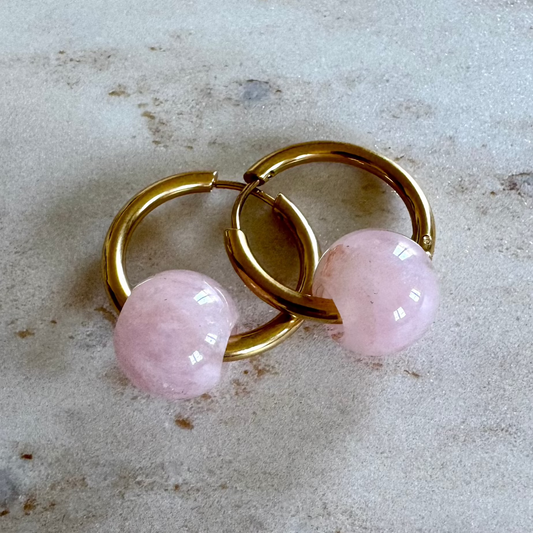
Maybe today you consciously choose the food your body is asking for instead of what you “should” eat. Maybe you cancel a meeting because you need rest. Maybe you wear the piece of jewellery that makes you feel strong, or get in touch with the person you have been thinking about for days. Every small experience shows you: I notice myself. I act on it. I can trust myself.
That said, intuition is not a free pass to ignore facts. When it comes to contracts, money, health or other people, information, consultation and responsible decisions are part of it. Your inner voice doesn't replace expertise. It adds something crucial to it: the question of whether a path truly suits you.
This combination of clarity and feeling is powerful. You don't have to choose between head and heart. Your mind can read the map. Your intuition can help decide where you want to travel.
When your intuition stays quiet
There are phases when you hear nothing. Not because you have no intuition, but because you are carrying too much. Constant stress, conflicts, lack of sleep and old hurts can drown out the subtle signals. Then it is not your job to dig even deeper for an answer. Then you are allowed to look after some relief first.
Fewer stimuli can already change a lot: switch off notifications, eat a meal without a screen, go to bed earlier or sit in silence for ten minutes. Movement also helps get your thoughts flowing again. Walk slowly, stretch, shake the tension out of your shoulders. Your body is not a project. It is your home.
If fears, distressing memories or a constant feeling of being overwhelmed are shaping your everyday life, professional support can be a loving and brave step. Intuition doesn't unfold under pressure. It needs safety, patience and compassion.
The right question changes everything
Instead of asking yourself “What should I do?”, try this question today: “What do I need right now to feel like myself again?” Maybe the answer is a clear conversation. Maybe a no. Maybe a hot shower, a moment with a candle or an evening without expectations.
Your inner voice doesn't demand that you are always brave, positive or completely clear. It is simply waiting for you to become quiet enough to hear it. And with every small moment in which you take yourself seriously, the soft whisper becomes a familiar strength that leads you home to yourself.