



















You know the moment: the day was full, your head even fuller, and yet there is a quiet feeling that something doesn't quite fit who you are. Maybe you say yes too often. Maybe you are holding on to a story that has long since become too small for you. Self-reflection as a compass doesn't mean overthinking every decision. It is the loving pause in which you learn to hear yourself again.
It doesn't lead with pressure but with attention. Beneath all the expectations, routines and outside voices, your own truth isn't waiting to be perfected. It wants to be noticed.
Why self-reflection is such a powerful compass
Self-reflection is an honest look inwards. You observe your thoughts, feelings, reactions and patterns without making yourself small. That sounds simple, but it can change a great deal: what you recognise, you no longer have to repeat unconsciously.
Perhaps you notice that a certain encounter leaves you drained every time. Perhaps you sense that your wish for recognition is louder than your wish for calm. Or you suddenly understand why a goal sounds good but doesn't feel alive. These insights are not judgements. They are clues.
Especially in times of change, self-reflection can give you something to hold on to. Not because it hands you all the answers straight away, but because it brings you back into relationship with yourself. You don't have to wait for a sign from the outside when your inner voice has long been trying to speak to you.
This isn't about always thinking positively. Spiritual growth can be uncomfortable too. Anger can point to a boundary. Envy can point to an unfulfilled wish. Sadness can tell you that something wants to be honoured or let go. Every feeling carries information if you are willing to give it space for a moment.
54 EVERYDAY SPIRIT GUIDE CARDS: your cards for honest self-reflection
The difference between self-reflection and overthinking
Looking inwards is not the same as getting lost in your thoughts. Overthinking often circles around guilt, fear and hypothetical scenarios. It asks: “What is wrong with me?” Self-reflection asks more gently: “What do I need right now? What is this situation trying to show me?”
The difference lies in your attitude. If you observe yourself in order to correct yourself, new pressure quickly builds up. If you observe yourself in order to understand yourself, clarity emerges. You can be honest without becoming harsh.
A good sign of helpful self-reflection is that it leaves you feeling a little more grounded at the end. You may not have a final solution yet, but you can sense a next step that feels right. If, on the other hand, your thoughts keep pulling you further into restlessness, it helps to step out of your head: go outside for some fresh air for a few minutes, take a warm shower, move your body or bring your attention to your breath.
A ritual that helps you hear your inner voice
Your insights don't always need a big fresh start. They often arise in small, recurring moments. A conscious ritual sends a signal: now this isn't about performance. Now it's about connection.
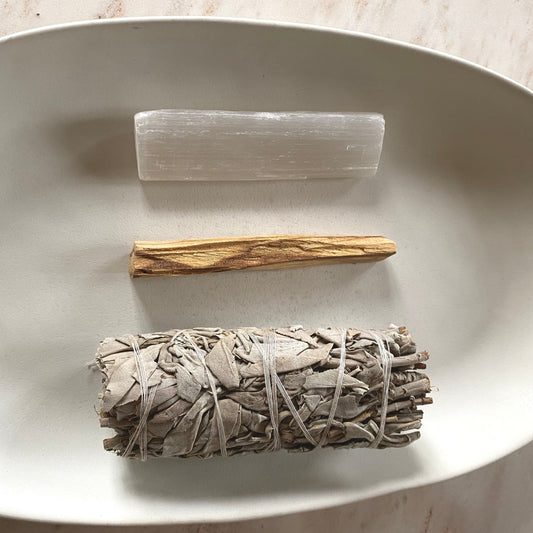
Choose a place where you feel comfortable. Light a manifestation candle, make yourself a cup of tea or hold a crystal whose energy speaks to you right now. It isn't the object alone that creates change. Its power also lies in the way it reminds you of your intention. A beautiful ritual object can be a gentle signal to yourself: I am allowed to slow down. It is safe to come home to myself.
Take ten minutes and write freely, without polishing your words. Begin with a sentence such as: “Today I am being truly honest with myself when I admit that ...” Then let the silence have its say too. Not every answer arrives as a clear thought. Sometimes it is a feeling in your body, an image or a sudden sense of relief.
If you would like more structure, these four questions can help:
- What gave me energy today, and what took it away?
- Where did I show myself as I truly am?
- Which situation particularly moved or triggered me?
- What would be a loving decision for my future self?
What matters is not answering these questions “correctly”. What matters is that you listen to yourself. A journal, an affirmation card or a small evening ritual can accompany you without becoming yet another task on your list.
Using self-reflection as a compass in everyday life
Self-reflection is at its most powerful not only in quiet Sunday moments but in the middle of life. Before an important conversation, you can ask yourself: Am I reacting from fear or from clarity? Before a purchase, a commitment or a decision: Do I really want this, or do I just not want to disappoint anyone?
The sentences you repeat to yourself deserve attention too. “I don't have time.” “I'm not ready yet.” “I'll never manage that.” Thoughts like these are not automatically true. They can be old protective patterns that once made sense and no longer fit your life today. You don't have to fight them. You can question them.
This is where an important nuance shows: self-reflection doesn't replace boundaries, conversations or concrete steps. If you notice that a relationship isn't good for you, it isn't enough to simply write the feeling down beautifully. Insight wants to be lived. Perhaps that means saying no. Accepting help. Voicing a request clearly. Or giving yourself permission to change direction.
Sometimes the next step is brave and visible. Sometimes it is quiet: going to bed earlier, not replying to a message straight away, no longer talking yourself out of a wish. Both count.
Intuition needs space, not perfection
Many people wish they could trust their intuition more. But intuition rarely gets loud when your inner world is drowned out by self-criticism. It grows in spaces where you believe yourself.
That doesn't mean every spontaneous impulse is a sign you have to follow blindly. With big decisions in particular, heart, mind and reality can all have their say. Your intuition can show you the direction while you still check the practical questions carefully. Magic and being grounded are not mutually exclusive.
Rituals help you nurture this connection consciously. Perhaps you draw an affirmation card in the morning and ask yourself where its message wants to be lived in a very concrete way today. Perhaps in the evening you cleanse your space with a scent that brings you calm and inwardly let go of the day. LETGOFLOW sees small acts like these as High Vibe Goods for your real life: beautiful reminders that your energy deserves attention.
When you meet yourself again
Self-reflection is not a project with an end date. You will change, and your answers will change with you. What was right a year ago may no longer fit today. That isn't a sign that you were wrong. It is a sign that you are in motion.
Don't expect to always be clear, calm and perfectly aligned. Doubt is part of it too. What matters is that you don't abandon yourself in it. Come back to yourself as often as you need to: with a question, a deep breath, a burning candle or a quiet moment by the window.
Perhaps your next answer doesn't lie in more effort. Perhaps it is waiting exactly where you stop overriding yourself and finally listen to yourself.